· By Victoria Piluso
Diaper Cream Ingredients to Avoid (And Why Your Routine is Too Complicated)
Diaper Cream Ingredients to Avoid (And Why Your Routine Might Be Making Things Worse)
Walk down any baby aisle and you'll find dozens of diaper creams promising to soothe, protect, and heal. The labels are full of reassuring words — natural, gentle, paediatrician recommended. But flip the tube over and look at the actual ingredient list, and a different picture emerges.
For parents trying to manage chronic diaper rash, understanding what's actually in these products — and what each ingredient does to your baby's skin — is more useful than any marketing claim. Here's what to look for, what to avoid, and why simpler is almost always better.
1. Zinc Oxide
Zinc oxide is the active ingredient in most white diaper creams and it does work as a physical barrier — it sits on top of the skin and deflects moisture away. The problem isn't the ingredient itself, it's the removal process.
Zinc oxide is designed to be durable. That's also what makes it so difficult to wipe off at the next change. Removing it typically requires significant friction — scrubbing at already-raw, inflamed skin to get the paste off before you can clean properly. For a baby with a rash, that mechanical stress at every change can be as damaging as whatever caused the rash in the first place.
A better principle: look for barrier products that protect without requiring scrubbing to remove. Lipid-based barriers — oils and waxes — protect through a similar mechanism but wipe away cleanly without friction.
2. Petroleum and Mineral Oil
Petrolatum (petroleum jelly) and mineral oil are among the most common ingredients in baby skincare, including many products marketed as natural or gentle. They're effective occlusives — they create a physical seal on the skin surface that repels moisture.
The issue is that they seal completely without allowing breathability. If any residual moisture, bacteria, or irritant is present under the layer when it's applied, it gets trapped there. For healthy skin this is rarely a problem. For already-compromised skin dealing with rash, trapping bacteria under a fully occlusive layer can actively prolong healing.
Both ingredients are also petroleum-derived, which gives some parents pause from a purity standpoint — particularly when applying to newborn skin multiple times a day.
3. Synthetic Fragrance and Masking Scents
Fragrance is the most well-known irritant in baby skincare, and most parents already know to look for fragrance-free options. What fewer parents know is that fragrance-free doesn't always mean what it implies.
Some products use masking fragrances — scents added specifically to cover the smell of other ingredients — which don't always appear prominently on the label. Others use natural fragrance ingredients like lavender, chamomile, or citrus extracts that are documented contact allergens for sensitive and eczema-prone skin, despite being technically natural.
The safest approach is to look for products with no fragrance of any kind — natural or synthetic — and to cross-reference the ingredient list with the National Eczema Association's list of known irritants if your baby has eczema or sensitive skin.
4. Preservatives in Water-Based Products
Water-based products — wipes and creams alike — require preservatives to prevent bacterial and mould growth. This is a legitimate formulation challenge, not a conspiracy. But it does mean that every water-based baby product comes with a preservative system, adding ingredients to a formula that's applied to newborn skin up to ten times a day.
Oil-based formulas, by contrast, are naturally resistant to bacterial contamination and require no preservative system at all — which means fewer ingredients, fewer potential exposure points, and a simpler formula overall. For parents who want to minimise the number of ingredients touching their baby's skin at every change, this is a meaningful practical difference.
5. Propylparaben and Butylparaben
While many parabens are considered safe for use in baby products, it's worth knowing that the EU has specifically restricted two of them — propylparaben and butylparaben — in leave-on products applied to the nappy area of children under three years old. This restriction reflects the EU's precautionary approach to ingredients applied repeatedly to skin that can become irritated and more permeable than usual.
In the US, no equivalent restriction exists. This means these ingredients remain common in American diaper creams despite being prohibited for this specific use in European baby products. It doesn't mean they're definitively harmful at the concentrations used — but for parents who prefer to err on the side of caution, it's useful information.
6. Talc
Less common than it once was, but still present in some combination powder-cream products. The American Academy of Pediatrics advises against talc-based powders near babies, citing inhalation risk during application close to a baby's face and ongoing quality concerns in talc sourcing. If a product contains talc, it's worth considering an alternative.
The Simpler Alternative
The common thread across most of these ingredients is that they exist to solve problems created by the conventional wipe-and-cream routine. Heavy occlusives are needed because cleansing strips the skin. Preservatives are needed because water-based formulas breed bacteria. Multiple steps are needed because no single product does the whole job.
An oil-based cleanser sidesteps most of these issues at the source. It requires no preservative system, leaves a breathable lipid barrier naturally, and contains no fragrance. The French diaper care tradition — liniment made from olive oil and limewater — has worked on this principle for generations, long before the modern diaper cream industry existed.
The best diaper routine is often the one with the fewest moving parts.
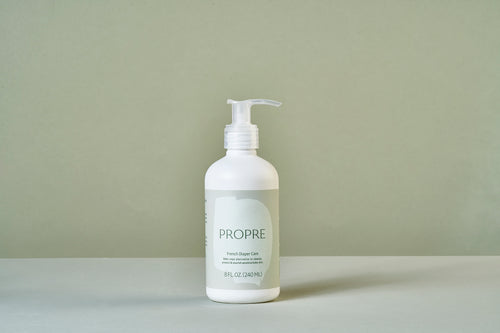
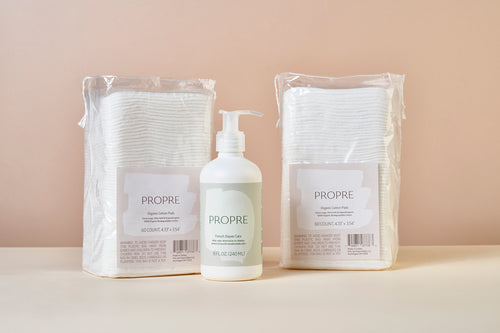
Propre Baby French Diaper Care is an oil-based liniment with no synthetic preservatives, no fragrance, and no petroleum derivatives. It carries the NEA Seal of Acceptance and is made to EU organic standards. You can find it here.